
South Atlantic Earthquakes |
|
Tristan da Cunha is in an active seismic region. 400 km west of Tristan da Cunha is the Mid-Atlantic Ridge. Here there is active sea-floor spreading as the South American and African Plates move apart. Frequent earthquakes accompany these plate movements and sub-marine volcanoes emit basalt lava, which cools rapidly into characteristic 'pillow' shapes. The active Tristan da Cunha Volcano and the extinct cones of Gough, Inaccessible and Nightingale Islands are not part of the Mid-Atlantic Ridge. Tristan is a hot-spot volcano, with magma rising from deep in the mantle. So local earthquakes may signal a subsequent volcanic eruption on the Tristan Volcano, which is some 5500 metres high from its base on the ocean floor to the top of the Peak, and 45 km across on the ocean floor. See The Tristan da Cunha Volcano Page for further details. |
Earthquake MonitoringOn Tristan itself there are a range of scientific instruments, including seismographs - see our separate Scientific Monitoring Page for details. This station is one of many across the world monitored constantly. The best source of information on recent earthquakes worldwide is the USGS site at: This lets you discover every major earthquake world-wide We aim to publish details of any local South Atlantic earthquakes and attempt to identify their tectonic situation. |
Earthquake Reports
Earthquake in Tristan da Cunha Region
Mid-Atlantic Ridge Earthquake 215 miles from Tristan
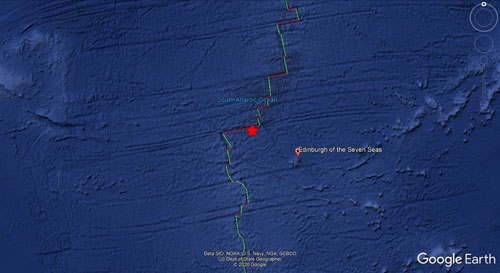
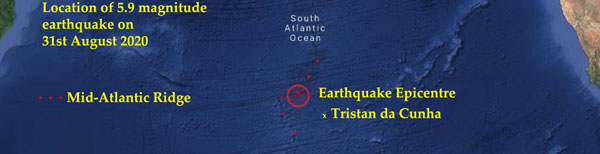
A 5.9 magnitude earthquake occurred on Monday 31st August 346km WNW of Tristan da Cunha at a depth of 10km. This earthquake is typical of many regular events along the Mid-Atlantic Ridge which lies some 350 km west of Tristan da Cunha. The ridge is the centre of sea-floor spreading as shallow magma convection currents push upwards and force the South American and African tectonic plates apart. The quakes are often accompanied by the eruption of basalt lava on the ocean floor, usually billowing out to form rounded shapes called 'pillow' lava, as they resemble cushions. Earthquakes of this magnitude are seldom felt on Tristan da Cunha, and are of no significance to the island community.
Tristan da Cunha itself is an active hot-spot volcano, fed by deep magma currents. Since the October 1961 eruption, which led to the evacuation of the entire Tristan population to the UK, there has been one submarine volcanic eruption in 2004, but no further significant seismic activity recorded. The island community is alert for any further locally centred earthquakes which may be the prelude to a future volcanic eruption. The Tristan Government has a Disaster Management Plan and holds periodic drills to revise procedures in the event of a volcanic emergency.
Disaster Evacuation Exercise
Disaster Evacuation Exercise
Report and photos from Inspector Conrad Glass
On Thursday 23rd August a Disaster Evacuation Exercise was conducted, assuming a serious emergency following the start of a volcanic eruption. The main purpose of this exercise was to highlight the importance to the community of having a valid passport, which is essential when travelling overseas.
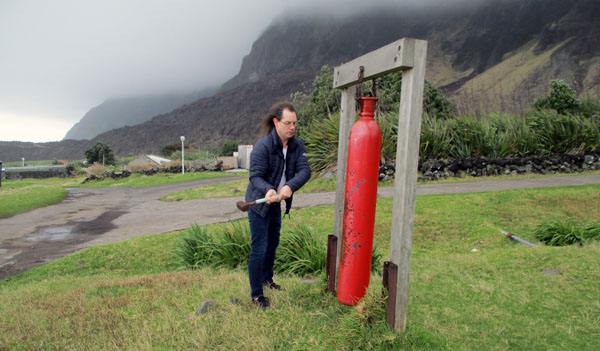
Acting Administrator David Moores ringing the gong
Exercise
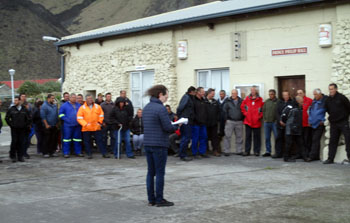
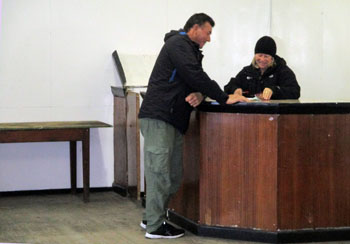
The Acting Admin David Moores rang the gong and all the heads of families met outside the Prince Phillip Hall to be briefed to summon family members to locations in the Prince Philip Hall, Albatross Bar and adjacent family room, where family / group stewards would check passports. On arrival David Moores and Conrad directed each family group to their steward.
Stewards
Paula Swain - Swain & Squibb Families; Sharon Glass - Glass family; James Green - Hagan Family
Cynthia Green - Green Family; Leon Glass - Rogers Family; Emma Swain - Repetto Family
Janine Lavarello - Lavarello Family; Iris Green - Expatriates
 |
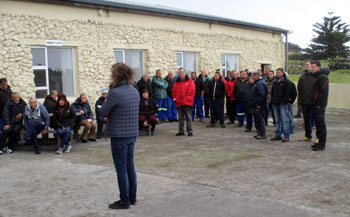 |
| Heads of families being briefed by David Moores outside the Prince Philip Hall | |
 |
 |
| Passports being checked by stewards | |
 |
 |
All went very smoothly with full corporation from the community. The exercise had the desired effect as the next day people who did not have a valid passport came to the police office to apply for a new passport. Sharon Glass is now busy with passport applications to ensure all have valid documents, essential for travel overseas.
5.5 magnitude earthquake on Mid-Atlantic Ridge: 6th October 2017
Report from USGS Website
An earthquake of magnitude 5.5 occurred on 6th October 2017 some 354.5 km WNW of Tristan da Cunha on the Mid-Atlantic Ridge. The focus was a depth of 10km. This earthquake is part of the usual sea-floor spreading associated with the Mid-Atlantic Ridge where the African and South American tectonic plates are being pushed apart by upwelling of magma in the earth's mantle.
Tristan da Cunha is not on the Mid-Atlantic Ridge but is a hot-spot volcano and part of the asisemic Walvis Ridge. We are reporting the event to re-assure friends of the island, as media sources quote that it is in the 'Tristan da Cunha region'. Nevertheless it is insignificant for the island community, and was not felt in the village. Therefore there is no alarm
Earthquake Report - 1st November 2016 |
 |
| A 5.0 magnitude earthquake was reported some 330km north-west of Tristan at a depth of 16.6km on 1st November 2016. 1-Nov-2016 |
|
Earthquake Report - 8th June 2016 |
|
| A 5.1 magnitude earthquake was reported some 500km SSW of Tristan at a depth of 10km on 8th June 2016. 8-Jun-2016 |
|
New Page: Tristan da Cunha Earth Science News |
|
| News concerning volcanic activity, earthquakes, weather and other earth science matters from the Tristan da Cunha group. 14-May-2016 |
|
Earthquake Report - 17th June 2015 |
|
| A 7.0 magnitude earthquake at a depth of 10km occurred on 17th June 2015 about 500km (300 miles) North-West of Tristan da Cunha. 17-Jun-2015 |
|
Disaster Management Planning |
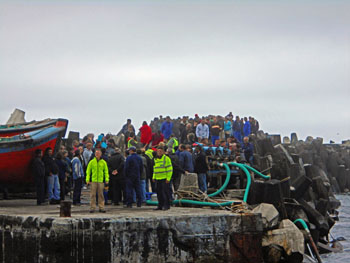 |
| Reports of evacuation drills carried out as the Tristan community plans for the possibility of future disasters such as earthquakes and volcanic eruptions. 5-Dec-2014 |
|
Earthquake Report - 2nd May 2013 |
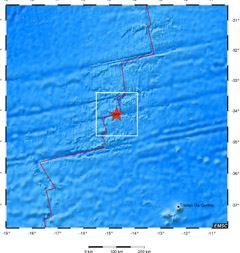 |
| An earthquake of magnitude 4.8 was reported 300 km (186 miles) NW of Tristan on 2nd May 2013 at a depth of 10km. 2-May-2013 |
|
- Earthquake Report - 4th February 2013 (4-Feb-2013) >>
- Earthquake Report - 26th January 2010 (26-Jan-2010) >>