Antarctic Terns (Sterna vittata tristanensis) or King Bird |
||
|
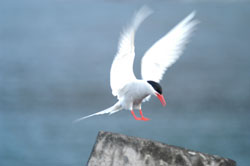
King Bird hovering |
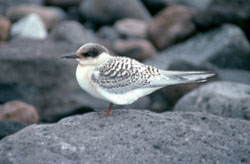
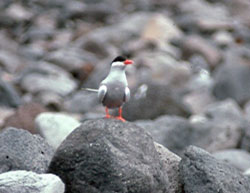
Appearance They are fairly small, grey and white terns with a full black cap, long outer tail steamers and striking red bill and legs in breeding plumage. Grey underparts contrast with a white cheek. |
A group of King Birds at Pigbite (Richard Grundy) |
|
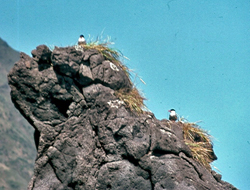
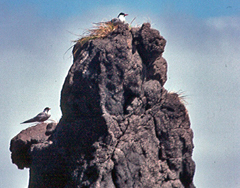
Two views of King Bird nests on stacks on Tristan's NW coast
|
Behaviour A few remain around the islands all year round, but most are present September - May. Breeding season is protracted as repeat clutches may be raised after earlier failures. Eggs are laid November - February with chicks fledging mid January - April. Nest sites are typically ledges on coastal cliffs and stacks, occasionally on boulder beaches. |
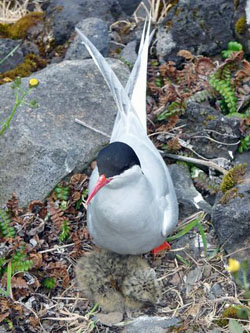
A King Bird with chick at the Potato Patches on 6th January 2010. |
| A 2010 nest was photographed by Robin Repetto on a wall in the Potato Patches, raising optimism that recent systematic rodent baiting has been successful, and indicating an increase in numbers as pairs seek less protected sites. | ||
|
Distribution Endemic to the Tristan da Cunha Islands and winters off South African south coast. Other subspecies breed on Antarctic Peninsula and sub-Antarctic islands, dispersing north in winter. |
||
|
Juvenile King Bird (Richard Grundy) |
Population Recent estimates suggest : 50 pairs on Tristan; 200 on Nightingale; 100 on Inaccessible and 500 at Gough. Conservation status is not threatened, though the species was far more common on Tristan, probably being displaced by rats and cats. |
Adult King Bird (Richard Grundy) |