Aftermath of the 7th July 2026 Storm
Report and photos from Administrator Philip Kendall
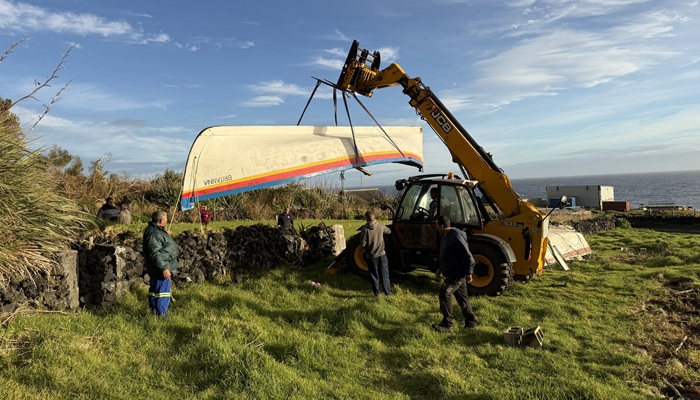
It was a relief that Tuesday and Wednesday's storm did not knock out Tristan's communications, and we have received the following report and photographs from Philip Kendall. The worst damage appears to have been confined mainly to the business part of the settlement, and thankfully there have been no casualties. However, Philip and his wife Louise were personally affected, as they had to evacuate the Residency after the 124mph (200km/h) gust recorded at 19:43 tore off part of the roof.

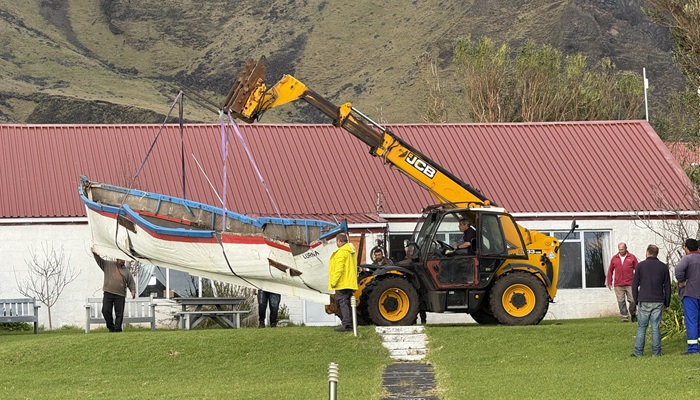
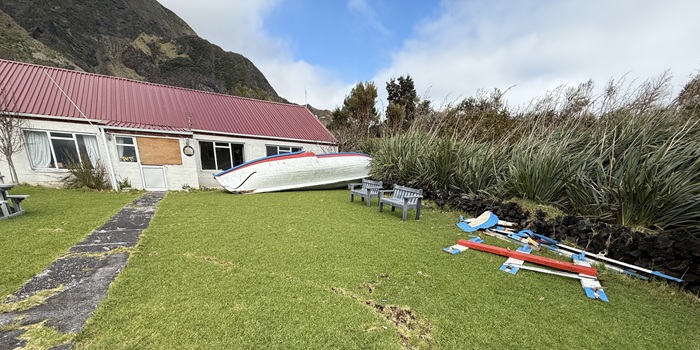
The scene in the Residency garden at daybreak, strewn with longboat debris. The longboat had been blown from the side of the road to the left in this picture, where they are all normally kept tied down.
Here are Philip's own words:
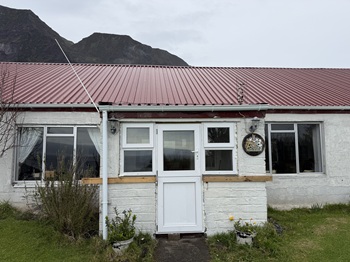
"Last night was the worst night of my life. The concerns for my own safety were by compounded by my concerns for Louise and of course overshadowed by my thoughts of the islanders. Louise and my departure from the Residency could not have been better timed, as within minutes, the front of the house was side swiped by a flying longboat which showered the lounge with glass where we had been sitting just moments earlier."

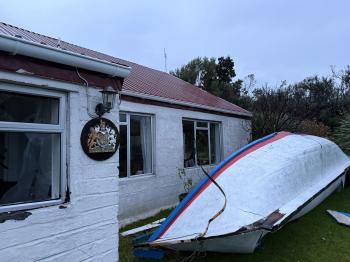
Another longboat straddles the Residency garden wall, but the Administrator's flag continues to defy the elements.
![]() |
![]() |
| The Residency's front door and living room windows were broken by the flying longboat. The longboat was itself badly cracked with bits torn off. |
|
![]() |
![]() |
| The main Residency living room, drenched and scattered with broken window glass. | |
![]() |
![]() |
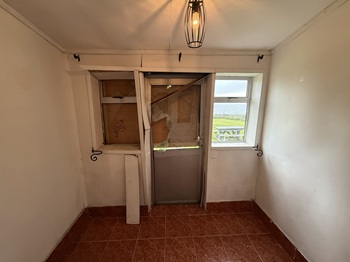
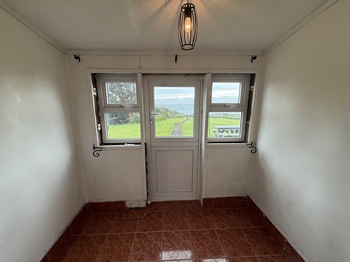
| The smashed Residency door from the inside, and later temporary repairs. | |
"Our experience was nothing compared to the devastation caused to one family, who I will not name to protect their privacy at this time, who were in their house as it was destroyed around them. They were remarkably unharmed physically, but the mental scars will remain for a long time, I am sure. The debris from their house broke through the windows of the Albatross Bar allowing the hurricane force winds to wreak havoc inside."

Flying debris from one of the houses broke windows at the Albatross Bar and chaos (below) in the interior.
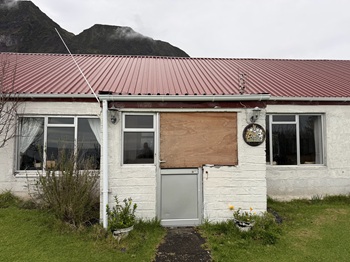
The broken windows have been temporarily boarded over.
![]() |
![]() |
"Today the island spirit came out in force, and we have been patching up buildings where possible, including the Residency, the Albatross bar and some storage sheds. Unfortunately, some buildings are unsalvageable, including the BioSecurity building, and a couple of the Communications offices. The BFBS receiver was also destroyed, so we have no TV, but the Starlink Antenna amazingly survived!"

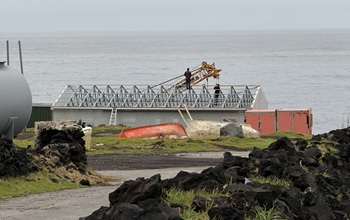
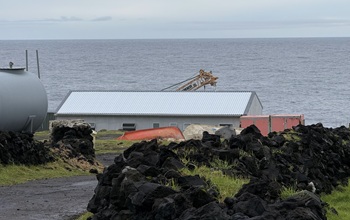
The relatively new Bioesecurity Facility lost its roof, and its interior (below) was totally devastated.
![]() |
![]() |
Some of the Other Damaged Buildings and Repair Work
![]() |
![]() |
| One of the PWD sheds lost a door and suffered damage to the roof. | |
![]() |
![]() |
| Damage to a family storage hut. | Damage to the RIB boathouse. |

Boarded up windows at the Residency.
![]() |
![]() |
| Alongside previous repairs, the Residency roof is gradually acquiring a 'coat of many colours'. | |
Initial repair work has concentrated on making buildings watertight and a certain amount of salvage. It will take many months to fully tidy up the settlement, make good all the damage and/or procure replacements.
Damaging Storm hits Tristan, 7th July 2026
Reports from Philip Kendall and Kelly Green. Video & stills from Fouche Conradie
Winter well and truly arrived on Tristan on Tuesday 7th July 2026, with a damaging storm. High winds grew to hurricane force winds during the day, with gusts of over 100mph, and were expected to continue into Wednesday. The Weatherlink website, which displays data from the automatic weather station mounted on St Mary's School, recorded a peak gust of 124mph (200km/h) at 19:43.

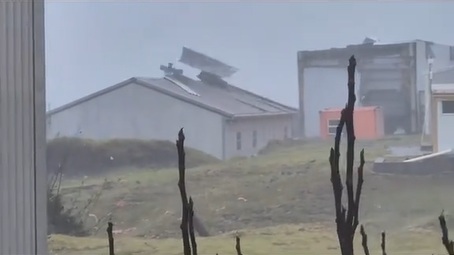
This still from a video shot by Fouche Conradie show roofing sheets being ripped off by the storm.
Among the damage caused, several buildings have lost their roofs, and the Administrator has issued instructions for everyone to shelter in place until the storm has passed.
Communications with island remained good at least until mid afternoon, enabling the Admin to send us notification, and for Kelly Green to post the video below on TikTok, which was shot by Ovenstone engineer Fouche Conradie. The current state of communications is not known, although the weather station is still sending data.
![]() |
|
| Stills grabbed from Fouche Condrie's video (right), show roofing debris flying through the air (above) and a building stripped of cladding by the wind (below). Big Point is just visible in the background. |
|
![]() |
Tristan's location in the middle of the South Atlantic means that the island is no stranger to damaging storms. The last such storms, for instance, happened in July and November 2019.
We will post further reports as and when they come in. We all earnestly hope and pray that everyone stays safe and that the damage is manageable.
Aurora Australis seen from Tristan
Report and photos from Tristan Enviroearth Station Manager Odile Cesari

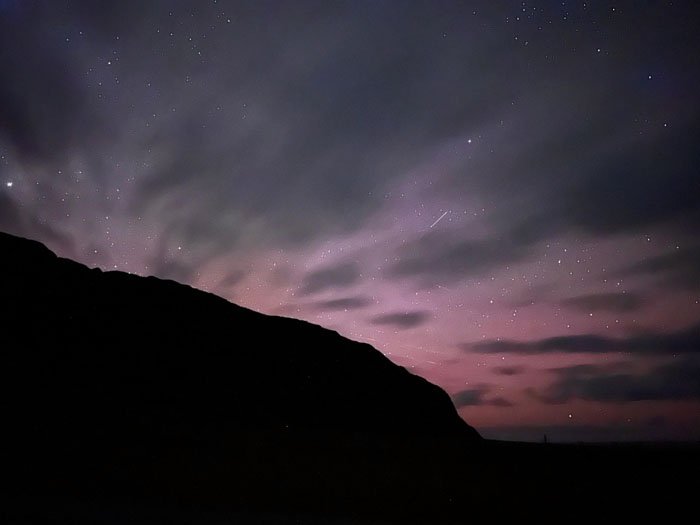
View from outside Odile's house

View from the Potato Patches later in the evening
Odile's Report
I took these two pictures of the Aurora Australis on 20th January 2026.
Before coming to Tristan, I lived in Iceland and in Canada, where my friends and I used to go aurora-hunting. Being my nostalgic self, I never deleted my aurora app, and on that evening in January, it sent me some alerts: "KP index is becoming high. Keep an eye on the sky."
Being quite far from the South Pole and living against the North flank of a huge volcano, I thought my chances were low, but that perhaps with a lot of luck, the red/purple glow of distant Southern Lights could be seen around the mountain. Well, the pictures speak for themselves! Although I can't say it was this bright and colourful in real life, I could not really see much of a warm glow with my bare eyes, the phone picked it up, and I edited the pictures slightly to make it stand out more.
That first picture was taken close to my guesthouse's gate (I am staying in Gaetano's Lodge!). As soon as I spotted a little bit of red on there, I got excited. I knew I had to get a clearer view south, and to get away from lights, so I immediately drove out to the Patches. But sadly, in the ten minutes it took to get there, the aurora activity had already started to decrease. The red glow faded away in a few minutes, after which my photos were back to a gorgeous but regular black and white night sky. I gave it half an hour to see if the lights would return, but the clouds took over the sky, as if to draw the curtains on a show that had ended, but that I was still happy to have witnessed.
About the January 2026 Solar Storm
These images were taken during a significant solar event in January 2026. It was caused by an X-class solar flare on Jan 18th, that sent a colossal, fast-moving CME (coronal mass ejection) directly toward Earth. This triggered a severe G4 geomagnetic storm, allowing auroras to be visible at an unusual distance from the poles. For context, G4 is the second-highest level a geomagnetic storm can reach. Under these conditions, solar radiation can cause temporary radio blackouts, disrupt or damage orbiting spacecraft and impact some ground-based infrastructure. In preparation for the storm, power grid operators reduced loads and activated protective systems, satellites were put into safe mode, airlines rerouted away from polar flight paths. The flare ionized the atmosphere over the Americas, particularly South America, causing some shortwave radio blackouts, and disturbed some GPS systems, but aside from that, didn't cause any damage.
A simultaneous S4 solar radiation storm occurred, a significantly rarer and less understood phenomenon. NOAA's GOES-19 satellite tracked an intense surge of high energy protons accelerating from the sun at speeds far above the typical solar wind. Those particles reached Earth in under 24 hours; most solar weather events take three to four days to cover the same distance. It ranked as the third most intense radiation storm in the 50 years of the GOES (Geostationary Operational Environmental Satellite) programme's measurements, and it was the strongest event observed since October 2003.
The Earth's atmosphere absorbs most of the solar radiation, which is why people on the ground face no direct risk. But astronauts in low Earth orbit don't have that protection, so the ISS crew had to take shelter in heavily shielded modules, as a precaution against elevated radiation exposure.
A Rare Observation
It was a combination of factors that allowed this sighting: the Sun still being close to its activity cycle's peak, the sky being mostly clear of clouds, the absence of a bright moon that would have washed out other light sources in the sky, particularly faint ones such as those Auroras. And of course, a fair amount of luck.
It is a good reminder that even in unlikely places, it's worth keeping an eye on the sky.
For those interested, the app Odile used is called My Aurora Forecast & Alerts (on iPhone), but there are several other apps out there offering the same features.
Background to the Southern Lights
The Aurora Australis, or Southern Lights, is a natural light display in the Southern Hemisphere caused by solar particles colliding with Earth's magnetic field. It is the exact same phenomenon as the Aurora Borealis (Northern Lights), but it is less photographed, as it occurs mostly over oceans and Antarctica, with relatively few nearby landmasses, and far fewer populated areas.
Primarily visible from Antarctica, Tasmania, New Zealand, and southern South America, Aurora Australis appears as colourful, dancing lights, usually from March to September. Peak activity occurs during solar maximums, one of which we just passed in 2025. The solar cycle length is impossible to predict, but it seems to average at 11 years, so we could expect the next solar maximum to be reached around 2036.
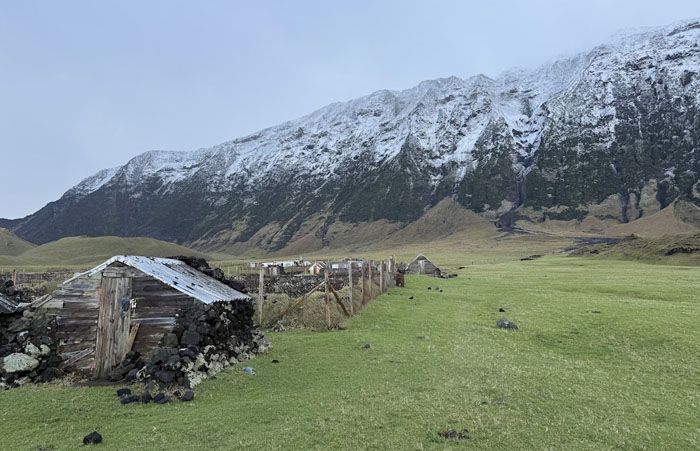
Snow lying exceptionally low on Tristan cliffs |
![]() |
| Snowfall visible above village may be the lowest recorded. 3-Sep-2025 |
|
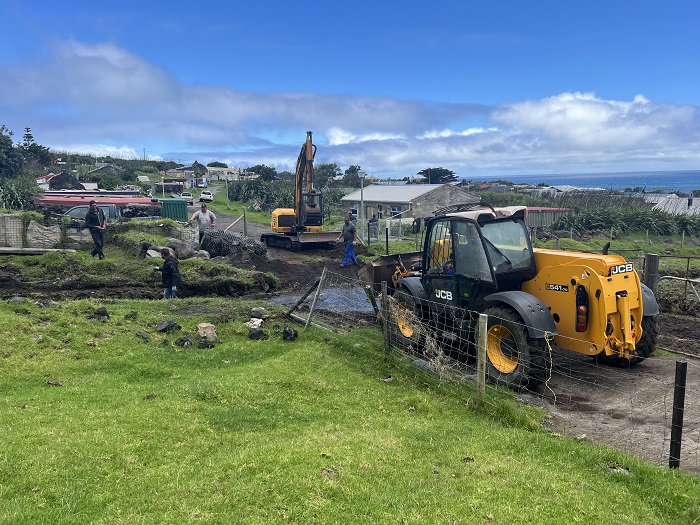
First Update on the February 2024 Flooding |
![]() |
| Update the weekend following flooding on the 2nd February 2024. 6-Feb-2024 |
|
New Flash Floods and Landslides on Tristan |
![]() |
| Heavy rain and landslides on the 2nd February 2024 caused flooding in many homes and blocked the road to the Patches. 3-Feb-2024 |
|
Tristan da Cunha Annual Gathering 2023 |
![]() |
| The gathering took place in Southampton on the 15th April 2023. 7-Jun-2023 |
|
Stamp issue: 60th Anniversary of Tristan's 1961 Volcano, Part 2 |
![]() |
| Stamps commemorating the 60th anniversary of the Royal Society Expedition 1961/62 to study Tristan's 1961 volcanic eruption. 2-Mar-2022 |
|
- 'Nothing Can Stop Us' Book Launch (16-Dec-2021) >>
- Stamp issue: 60th Anniversary of Tristan's 1961 Volcano, Part 1 (27-Oct-2021) >>
- Remembering the 1961 Volcano (18-May-2021) >>
- Heavy Rainstorm, 30th April 2021 (30-Apr-2021) >>
- Partial Solar Eclipse, December 2020 (19-Dec-2020) >>
- Earthquake in Tristan da Cunha Region (2-Sep-2020) >>